
There are exhibitions that show you art, and there are exhibitions that show you yourself. And it may be a very unfiltered image of yourself. Banksy Limitless, housed in the Sussex Mansions in South Kensington, attempts both - and in its best moments, it succeeds. Stepping inside feels like stepping through the looking glass of the 21st-century world. Part retrospective, part fun-house (it would be funny if it weren’t true), and part moral interrogation - every corner of this exhibition is lined with a provocation.
The first stretch is a kind of documentary tunnel. Along the walls runs a meticulous timeline of Banksy’s life and works, charting the years not as milestones of success but as waves of protest. Each date anchors a moment: the Bristol nights when a spray can was his passport to visibility, the walls of Bethlehem, the auction houses where his art literally destroyed itself. Accompanying text gives context - where he was, what he was fighting, what the world looked like that year. Even this introductory passage holds tension: between vandalism and uplift, between moral right and legal constraint, and between the artist’s desire for invisibility and the public’s obsession with unmasking him. A short film at the end stitches together global headlines - Gaza, Brexit, Ukraine, the art-market circus – underscoring how Banksy’s career shadows our collective anxieties. It is less about biography than zeitgeist: the political weather that produced him.
Są wystawy, które pokazują ci sztukę, i są wystawy, które pokazują ci ciebie samego. I to całkiem bez filtrów. Banksy Limitless, mieszcząca się w Sussex Mansions w South Kensington, próbuje robić jedno i drugie - i w swoich najlepszych momentach naprawdę jej się to udaje. Wejście na teren tej wystawy przypomina przekroczenie zwierciadła XXI wieku. Częściowo retrospektywna, częściowo gabinet osobliwości (byłoby śmieszniej, gdyby nie było aż tak prawdziwie), a częściowo moralne przesłuchanie - każdy zakątek tej wystawy obudowany jest prowokacją.
Pierwszy fragment to rodzaj dokumentalnego tunelu. Na ścianach biegnie dość szczegółowa oś czasu twórczości Banksy’ego, która odmierza lata nie tyle jako kamienie milowe sukcesu, co jako fale protestu. Każda data zakotwicza jakiś moment: bristolskie noce, kiedy puszka ze sprayem była jego paszportem do widzialności; mury Betlejem; domy aukcyjne, w których jego sztuka dosłownie sama się niszczyła. Towarzyszące teksty nadają kontekst – gdzie był, o co walczył, jak wyglądał wtedy świat. Nawet ten wstępny fragment wystawy niesie napięcie: między wandalizmem a podnoszeniem na duchu, między moralną słusznością a prawnym ograniczeniem, między pragnieniem anonimowości a publiczną obsesją na punkcie jego demaskacji. Krótki film na końcu sumuje globalne nagłówki - Gaza, Brexit, Ukraina, cyrk rynku sztuki - podkreślając, jak kariera Banksy’ego odbija nasze zbiorowe niepokoje. To mniej biografia, a bardziej zeitgeist: polityczny klimat, który go ukształtował.




Then, through a cartoon-style security door - one of the original props from Dismaland, his dystopian theme-park installation - we cross from documentation into theatre.
The first rooms feel like stripped galleries: white, raw, with concrete floors and silver industrial air ducts. It can be seen as a deliberate aesthetic friction - the street or a warehouse repackaged as museum. Banksy’s work thrives on such contradiction - rebellion dressed as institution, vandalism sold with a time slot.
Every surface here bears something iconic. Saints of Banksy’s mythology - Bomb Hugger, Laugh Now, Barcode Leopard, GDP Rat, Stick Police, and many others are framed, captioned, and lit, their raw edges polished by the museum glow. White sculptures punctuate the space: a muscular Bullet Proof David; a famous elephant with strapped ballistic rocket. Some other walls depict destruction of war for freedom of Ukraine with rabble covered in his graffiti.
Potem, przez kreskówkowe drzwi bezpieczeństwa - jeden z oryginalnych rekwizytów z Dismaland, dystopijnej instalacji Banksy’ego w formie parku rozrywki – przechodzimy od dokumentacji do teatru.
Pierwsze sale przypominają ogołocone galerie: białe, surowe, z betonowymi podłogami i metalicznymi przemysłowymi kanałami wentylacyjnymi. Można to odczytać jako celowe estetyczne napięcie - magazyn przemysłowy przepakowany w muzeum. Twórczość Banksy’ego żywi się takimi sprzecznościami - bunt przebrany za instytucję, wandalizm sprzedawany na godziny.
Każda powierzchnia tutaj niesie coś ikonicznego. Święci Banksy’owej ikonografii – Bomb Hugger, Laugh Now, Barcode Leopard, GDP Rat, Stick Police i wiele innych prac - oprawione, opisane i oświetlone, ich surowy przekaz wypolerowany muzealnym blaskiem. Przestrzeń punktują też białe rzeźby: muskularny Bullet Proof David czy słynny słoń z przypasaną rakietą dalekiego zasięgu. Inne ściany z kolei starają się oddać ogrom zniszczeń podczas wojny o wolność Ukrainy, gdzie zniszczone ściany pokrywają graffiti Banksy’ego.


On one of the walls hangs Love Is in the Bin, the shredded remains of Girl with Balloon from its notorious Sotheby’s moment. We see the self- destructive mechanism that devoured half the canvas as the auctioneer’s hammer fell - a perfect metaphor for art devouring itself under capitalism’s spotlight.
Na jednej ze ścian wisi Love Is in the Bin, czyli postrzępione szczątki Girl with Balloon z jej słynnego momentu w Sotheby’s. Widzimy mechanizm autodestrukcji, który pożarł połowę płótna w chwili, gdy opadł młotek licytatora - idealną metaforę sztuki pożerającej samą siebie w świetle kapitalistycznych reflektorów.

A mural of Love Is in the Air dominates one corridor, a protestor frozen mid-throw, in his hand flowers instead of a weapon. Visitors instinctively pose beside it, smiling to the camera - revolution turned into Instagram backdrop.
Mural Love Is in the Air dominuje jeden z korytarzy - protestant zastygły w półrzucie, w dłoni trzyma nie broń, lecz kwiaty. Odwiedzający instynktownie pozują obok niego, uśmiechając się do aparatu - rewolucja zamieniona w instagramową dekorację.


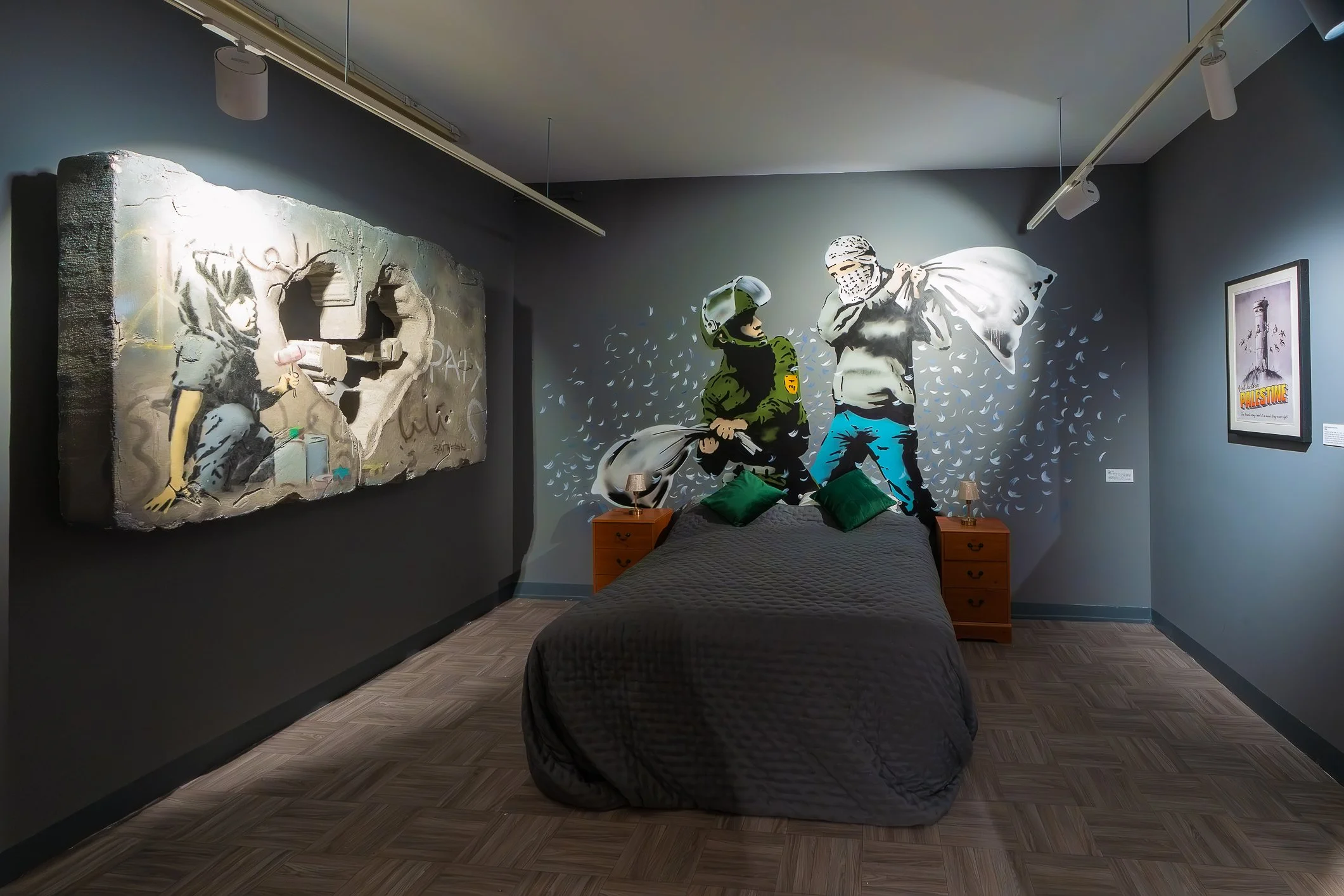
The atmosphere in those rooms hums with tension: satire made sacred, protest institutionalised. More familiar images - No Ball Games, Donut Van, Girl with Balloon - cluster around like echoes from a collective conscience. A small screen plays an animated short about the girl and her balloon, turning sentimentality into something even more fragile and haunting. A reconstruction of the Walled Off Hotel’s facade, guarded by a chained chimpanzee, reminds us that Banksy’s world blends absurdity with menace.
Atmosfera w tych salach jest pełna napięcia: satyra wyniesiona do rangi sacrum, protest zinstytucjonalizowany. Bardziej znajome obrazy - No Ball Games, Donut Van, Girl with Balloon - zgromadzone są wokół jak echo zbiorowej podświadomości. Na małym ekranie prezentowana jest krótka animacja o dziewczynce i jej balonie, zamieniając sentymentalność w coś jeszcze bardziej kruchego i jednocześnie strasznego. Rekonstrukcja fasady Walled Off Hotel, strzeżonej przez przykutego łańcuchem szympansa, przypomina, że świat Banksy’ego miesza absurd z grozą.




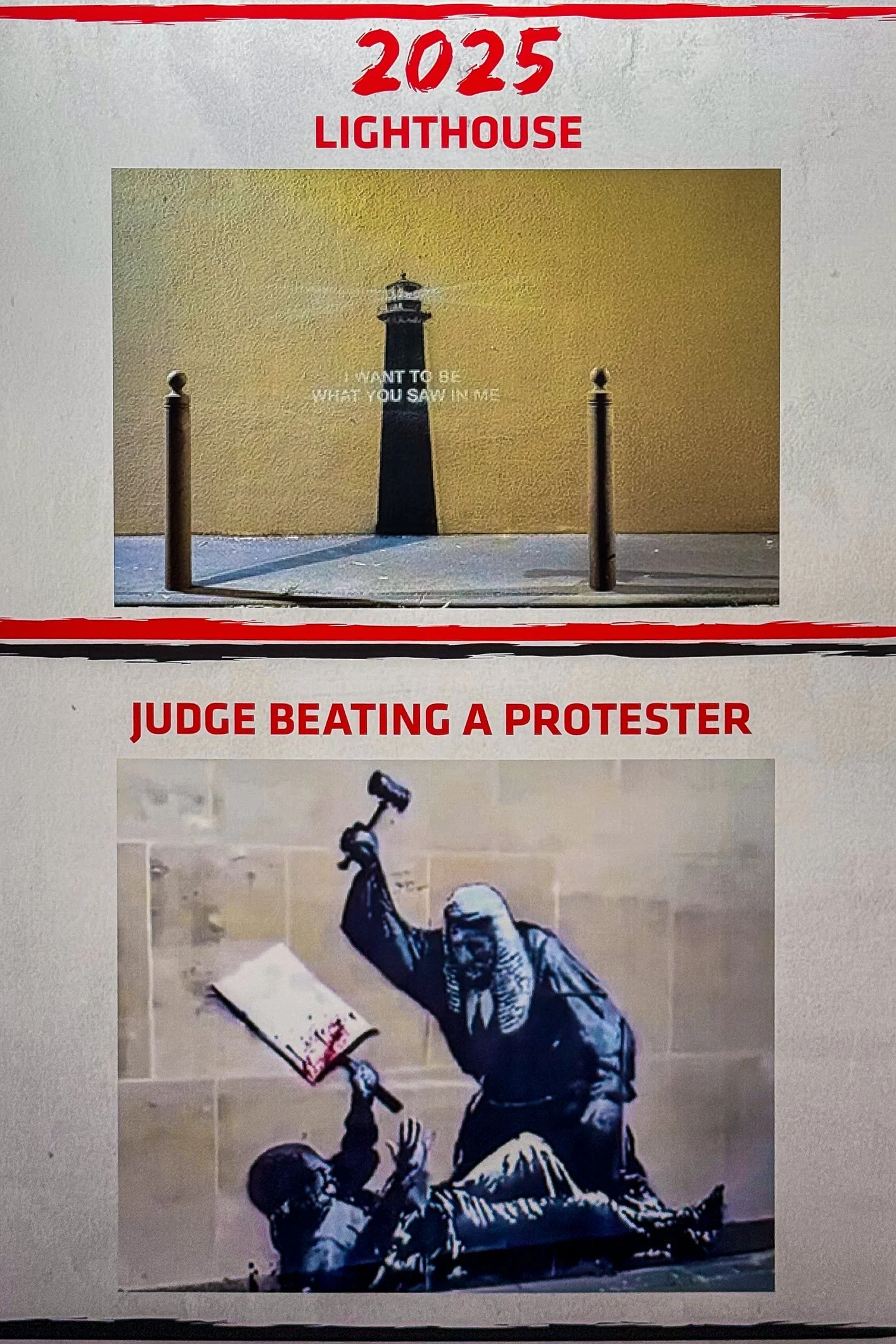
The next room is darker, its atmosphere even heavier. One side is dominated by a huge recreation of Devolved Parliament, the absurdist canvas in which the House of Commons is filled with chimpanzees. The atmosphere is half-cathedral, half-circus. Nearby hang Lenin in Sight, Morons, and other provocative works. Opposite, an enormous mural depicts a Judge Beating a Protestor (recently removed from the facade of Queen’s Building in London). In the corner of the same wall there is I Fought the Law and I Won and I cannot decide if it hints at hope to win, or simply necessity of defiance and persistence, even when the win may be small and symbolic.
Kolejna sala jest ciemniejsza, a jej atmosfera jeszcze cięższa. Jedną ze ścian dominuje ogromna rekonstrukcja Devolved Parliament, absurdystycznego płótna, na którym Izbę Gmin brytyjskiego parlamentu wypełniają szympansy. Atmosfera jest trochę jak w katedrze, a trochę jak w cyrku. W pobliżu wiszą Lenin in Sight, Morons i inne prowokacyjne prace. Naprzeciwko rozciąga się monumentalny mural przedstawiający Judge Beating a Protestor (usunięty ostatnio z Queen’s Building w Londynie). W rogu tej samej ściany znajduje się I Fought the Law and I Won - i nie potrafię zdecydować, czy sugeruje ono nadzieję na zwycięstwo, czy raczej konieczność nieustannego sprzeciwu i wytrwałości, nawet jeśli wygrana jest mała i wyłącznie symboliczna.


Behind that wall, the exhibition turns inward. Here is Banksy’s dialogue with art history - his re-seen masterpieces. Sunflowers from Petrol Station, where Van Gogh’s blossoms have withered, Show Me the Monet, where the lily pond is choked with shopping carts. Graffiti Village, CCTV Countryside, The Banality of the Banality of Evil, Vettriano’s Lovers, even Simon Cowell Judges the Ballet. These rewritings are not mere vandalism of classics; they show how the world itself – through consumerism, surveillance, environmental degradation, mass production, loss of privacy - has become the vandalised canvas.
Some of these works have been planted in Banksy’s famous museum “pranks”. For example, in October 2003, Banksy entered Tate Britain disguised as a pensioner and installed Crimewatch UK Has Ruined the Countryside for All of Us in a vacant gallery slot. On 13 March 2005, he placed works simultaneously in four major New York museums - the Met, MoMA, the Brooklyn Museum, and the American Museum of Natural History - using a fake beard/hat to blend in as a visitor, and strong glue to fix the painting to the wall. This is an example of Banksy’s method of infiltration and critique: entering elite cultural institutions unannounced to place his own work, thereby questioning notions of legitimacy, curation and who gets to decide what art is. It also highlights his interest in institutional critique: by placing the work “inside” the system, he forces the system to respond (remove it, comment on it, etc.).
Kolejna część tej wystawy to dialog Banksy’ego z historią sztuki – jego „ponownie zobaczone” arcydzieła. Sunflowers from Petrol Station, w których słoneczniki Van Gogha zwiędły; Show Me the Monet, gdzie staw lilii dławią wózki sklepowe. Graffiti Village, CCTV Countryside, The Banality of the Banality of Evil, Vettriano’s Lovers, a nawet Simon Cowell Judges the Ballet. Te przeróbki nie są zwykłym wandalizowaniem klasyków; pokazują raczej, że sam świat - poprzez konsumpcjonizm, inwigilację, degradację środowiska, masową produkcję, utratę prywatności - stał się zdewastowanym płótnem.
Część z prezentowanych tu prac została „podrzucona” w słynnych muzealnych „psikusach” Banksy’ego. Na przykład w październiku 2003 roku Banksy wszedł do Tate Britain przebrany za emeryta i umieścił Crimewatch UK Has Ruined the Countryside for All of Us w jednym z wolnym miejsc na ścianie. 13 marca 2005 roku umieścił swoje prace jednocześnie w czterech głównych nowojorskich muzeach - Met, MoMA, Brooklyn Museum oraz American Museum of Natural History - używając fałszywej brody i kapelusza, by wmieszać się w tłum, oraz mocnego kleju, by przytwierdzić obrazy do ściany. To przykład metody infiltracji i krytyki Banksy’ego: wchodzenia niepostrzeżenie do elitarnych instytucji kultury, by ulokować tam własną pracę, a tym samym zakwestionować pojęcia legitymizacji, kuratorstwa i tego, kto ma prawo decydować, czym jest sztuka. Podkreśla to również jego zainteresowanie krytyką instytucjonalną: umieszczając pracę „wewnątrz” systemu, zmusza system do reakcji (usunięcia jej, skomentowania itd.).


A side corner amplifies industrial tension: brick walls, streaked with deep red and cobalt blue light, showcase Banksy’s August 2024 London animal series. A mountain goat balances precariously, a gorilla lifts a shutter to reveal a sea lion and escaping birds, glowing eyes peer from the shadows, and a cat arching close to a scratched wall.
Boczny zakątek tej sali wystawowej potęguje industrialne napięcie: ceglane ściany, spowite głęboką czerwienią i kobaltowym błękitem laserowego światła, prezentują londyńską serię zwierzęcą Banksy’ego z sierpnia 2024 roku. Koziorożec balansuje na samej krawędzi ściany, goryl podnosi roletę, odsłaniając uchatkę i uciekające ptaki, jarzące się oczy wyglądają z cienia, a kot wygina grzbiet tuż przy podrapanej ścianie.


